Uganda and the Shades of Political Gray
“What is a rebel?” asked Albert Camus, who answered his question and said: “A man who says no.”
The conclusion of the recent elections in Uganda has once again brought to the fore questions about the future of the country. Yoweri Museveni, the incumbent President of Uganda, has a steadily declining popularity. The decline in popularity does not prevent him from hanging on to power or suppressing any dissent that may arise against his regime. This was witnessed in the elections and the campaigns preceding the elections. Museveni came down hard against dissenters and opposition leaders like Robert Kyagulanyi. The youth leader Kyagulanyi, popularly known as Bobi Wine, was arrested multiple times during his campaign even for parking in the wrong spot. Could one in a truly democratic country imagine a Presidential candidate being arrested for a traffic violation whilst campaigning? The arrests and disruption of campaigning of the opposition using state machinery did not just stop at traffic violations. Seeing Kyagulanyi’s mass youth following on social media, the government banned social media and messaging apps across the country days ahead of the elections. Using state machinery to subdue the opposition is a feature of authoritarian regimes, but one may wonder under what category does Uganda fall into? An authoritarian regime that allows certain democratic functions.
The State of Uganda – A Hybrid Regime
Elections in Uganda is like playing a game of chess, but no matter your moves you’re rigged to lose every single time. However, you are given the opportunity to play the game. This opportunity is the garb of democracy under which states like Uganda operate. Such countries fall into the political gray zone, that is, being neither authoritarian nor democratic. The political term for such countries is ‘hybrid regimes’. Democracy under normal circumstances would not only require the conduction of “free, fair, and competitive elections, but also the freedoms that men them truly meaningful, alternative sources of information, and institutions to ensure that government policies depend on the votes and preferences of citizens”. This conception of democracy is known as ‘polarchy’. However, under the third wave of democratisation ambiguous states like the one under discussion have come into existence. States like Uganda allow regular, competitive, multiparty elections but at the end of the day only the ruling party is going to win. This is because the said party controls the state machinery, more importantly, the security apparatus, which they can use to subdue the populace in case some decide to turn revolutionary after the elections.
Internal Change Essential for Sustainable Existence
However, it does not mean that such countries are beyond repair. There are two mechanisms to deal with such countries: the first being internally by slowly but steadily building a movement that rejects such regimes and the other mechanism being through diplomatic means. But experience has shown that the second option can and usually does turn unsavoury given the interests of the third party that intervenes. The first option too has constraints and would require a dedicated opposition which does not succumb to pressures of the regime and is also supported by the judiciary of the state to some extent. In the case of Uganda, the opposition is young and dedicated and but support from the judiciary cannot be expected. The Supreme Court has previously in 2001, 2006 and 2016 dismissed petitions for cancellation of Museveni’s re-elections. An independent judiciary would be a fairy tale for Ugandans because it would have the power to oust the regime legally.
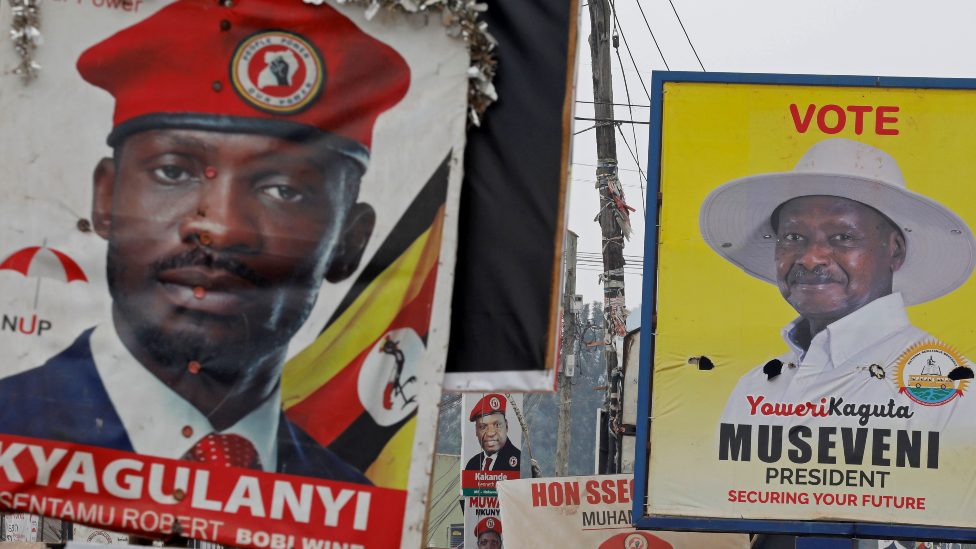
Photo Credit: BBC News
Can Change Happen?
So if the system is rigged to make Museveni win in perpetuity, how then will change dawn upon Uganda? Roger Peterson, the author of Resistance and Rebellion: Lessons from Eastern Europe, says that there are three phases to a rebellion. This has to begin from what Peterson recognises as a shift from “regime neutrality” to “widespread but unorganised and unarmed resistance”. This phase is basically when realisation dawns upon a group of conscious people who become opposed to the regime and then hold the key to inspiring others to see the light. Uganda, after the recent elections under Kyagulanyi, is already in this phase. The second phase of Peterson’s rebellion is armed rebellion followed by the final phase which is maintaining the armed rebellion. While Uganda is far from the second and third phases of a rebellion, people in the country have to, as Peterson says, abandon the “deal with the autocratic regime that sees people accept certain benefits such as employment and education in favour of different values like dignity”. Once the populace comes out in numbers opposed to the regime then the institutions like the military and judiciary will slowly shift their attitude to supporting change as well because after all the institutions too are made of impressionable individuals.
Kyagulanyi, also affectionately known as the ‘ghetto president’, and his band of youth followers have another weapon in their arsenal — social media. It will help spread the word of a possible uprising, thereby increasing the people, who will be the first ones to oppose the regime and foment a rebellion. Secondly, while in the days gone by dictators could quietly go about their business behind their borders, social media has made the experiences of people living under authoritarian regimes more accessible. It will be easier for a movement in Uganda to gain traction abroad as well due to the presence of social media making it harder for democratic super-powers to ignore the change waiting to happen. While change will not come in a day or two because getting rid of regime is like felling a tree, it’s a long and arduous process.